ED and low T are different problems
It helps to think of them as plumbing versus fuel.
Erectile dysfunction is a plumbing problem. The nerves and desire are working, but blood isn't flowing into the penis the way it should, so you can't get or keep a firm erection. ED is overwhelmingly about blood vessels and, sometimes, the arousal signal from the brain. It's extremely common and very treatable.
Low testosterone is a fuel problem. Testosterone is the hormone behind male sex drive, energy, muscle, mood, and more. When it drops too low - a condition doctors call hypogonadism or testosterone deficiency - the classic signs are low libido, fatigue, low mood, loss of muscle, and reduced motivation. Low T can contribute to ED, but it usually shows up first as a drop in desire, not a mechanical failure of the erection.
The reason this matters: the treatments are completely different, and only one of them carries the fertility and long-term commitments described below.
How to tell which one you have
No article can diagnose you, but the pattern of symptoms is a useful clue.
This looks more like ED: you still want sex - the desire is there - but you can't get hard, or you lose the erection before or during sex. Morning erections may have faded. Everything else feels normal.
This looks more like low testosterone: your sex drive itself has dropped, alongside persistent fatigue, low mood, difficulty building or keeping muscle, and a general lack of drive. Trouble with erections may be present, but it comes packaged with those broader symptoms.
The honest answer for a lot of men is "some of both," which is exactly why the order of treatment matters.
Why ED treatment comes first
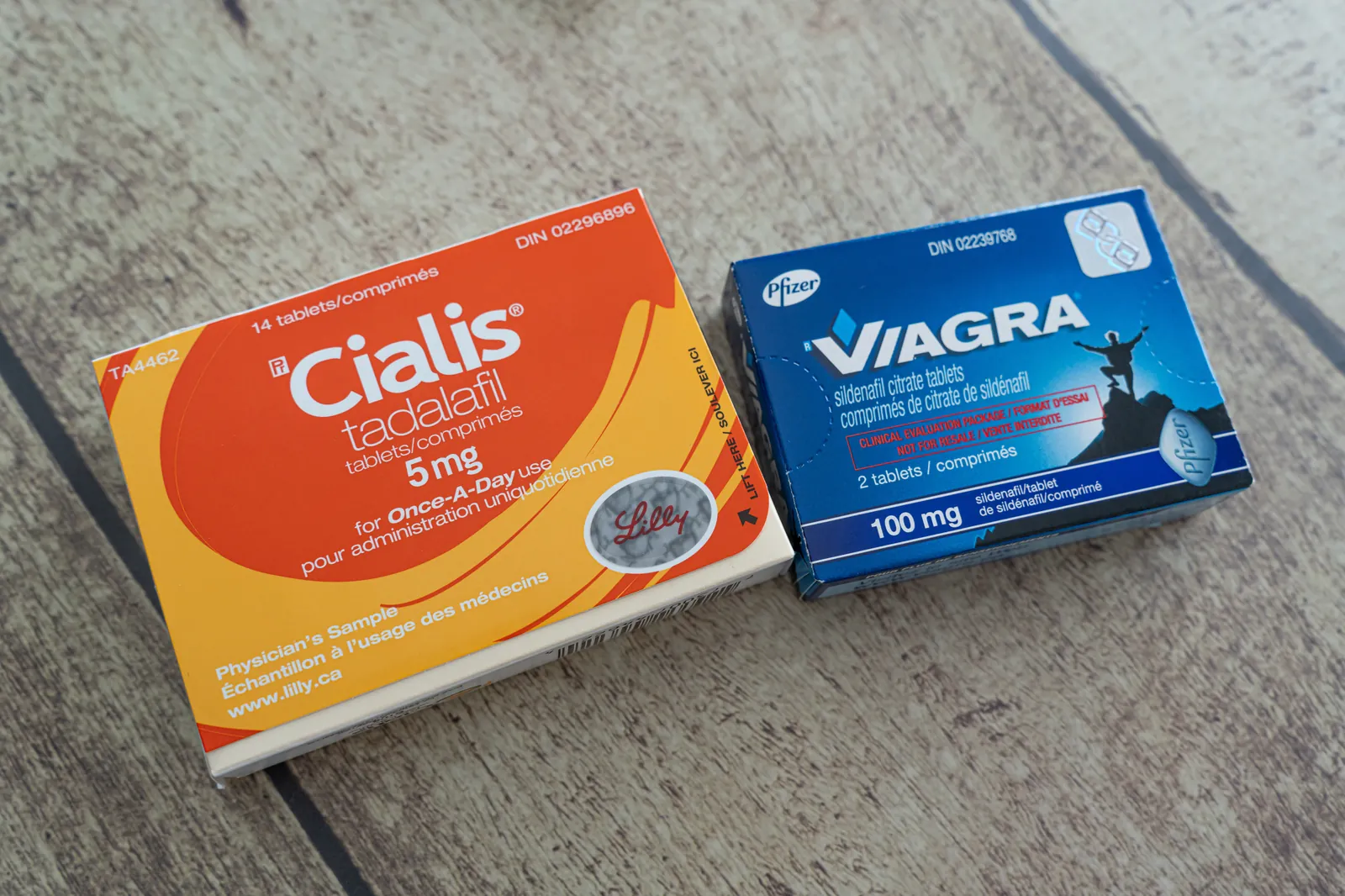
For the problem of getting and keeping an erection, the first-line treatment isn't testosterone - it's a PDE5 inhibitor. Sildenafil (Viagra) and tadalafil (Cialis) improve blood flow to the penis and are recommended as first-line therapy for most men with ED by the American Urological Association1, because they're effective and well-tolerated. Crucially, they work whether your testosterone is high, low, or normal.
They also work for the large majority of men: in clinical use, most men on a PDE5 inhibitor achieve firm erections suitable for sex. HELMD's own treatment, Drive, builds on this - a compounded sublingual tablet that pairs sildenafil and tadalafil with apomorphine, which acts on the brain's arousal pathway.
So if your issue is mechanical - the desire is there but the erection isn't - ED medication is the direct, proven, low-commitment answer. There's usually no reason to start with testosterone.
A short online visit lets a licensed provider review your symptoms and recommend an approach that fits.
Where testosterone actually fits
Testosterone therapy has a real, legitimate role - but a narrower one than the marketing suggests.
It's appropriate for men with genuinely low testosterone confirmed by lab testing, plus symptoms of deficiency (low libido, fatigue, low mood). In those men, testosterone can restore sex drive, energy, and well-being - the things low T actually takes away.
What it does not reliably do is fix the erection itself. Trials of testosterone alone for ED show inconsistent, generally modest effects on erectile function; the benefit is mostly to libido. Where testosterone earns its keep for erections is in combination: for men who have both confirmed low T and a poor or borderline response to a PDE5 inhibitor, adding testosterone can improve results beyond the PDE5 inhibitor alone. In other words, testosterone is a supporting player for erections, not the lead - and it's most useful precisely when standard ED treatment isn't quite doing the job.
The "won't shut you down" options
The biggest drawback of standard testosterone therapy - shutting off your own production and your fertility - has created a market for alternatives that promise to raise testosterone without flipping that switch. Two come up most: nasal testosterone and a class of pills called SERMs. Both are real, and both are more complicated than the marketing lets on.
Nasal testosterone (Natesto)
Natesto is a testosterone gel you apply inside the nose three times a day. Because each dose is short-acting, your brain's hormone signals (LH and FSH) don't get fully switched off the way they do with injections or long-acting gels - so your testes keep working. In a small clinical trial, testosterone rose into the normal range while most men held onto their sperm counts: about 9 in 10 kept a healthy motile sperm count over six months. It's not a guarantee, though - a minority of men still saw their counts drop, and a few went to zero (all recovered after stopping).
The catches are practical, too. Dosing three times every day up the nose is a real hassle compared with a once-a-day pill, the effect tends to be less consistent than standard therapy, and the fertility data only runs to about six months - there's no long-term evidence yet. It's a legitimate niche tool, not a free lunch.
SERM pills (enclomiphene, clomiphene)
These are pills that nudge your own body to make more testosterone rather than replacing it from outside, so they too preserve fertility. Here's the honest part most clinics skip: they reliably raise the number on your lab report without reliably making you feel better. In trials, testosterone climbed meaningfully (on the order of 250 to 275 ng/dL), yet improvements in symptoms and sexual function were inconsistent - plenty of men don't notice much, and some report mood changes, low energy, or lower libido. They're used off-label for this, and the long-term data is thin.
The lesson across both: raising a testosterone number is not the same as fixing how you feel or how you perform. And if the actual problem is the erection, none of these hormone routes is the direct answer - ED treatment is.
The catches of testosterone therapy
Even when it's appropriate, testosterone therapy is a bigger decision than a pill for sex. Four things are worth understanding before you start.
1. It can end your fertility
This is the big one, and it surprises most men. Taking testosterone from an outside source signals your brain to shut down its own production - and that same shutdown switches off sperm production. Testosterone therapy can drive sperm counts to zero (azoospermia), which is why it has even been studied as a male contraceptive. The American Urological Association is explicit: clinicians should not prescribe testosterone to men who want to father children now or in the future.
It doesn't always reverse cleanly, either. After stopping, most men recover sperm within about six months, but a meaningful minority take a year or more, and recovery to a man's original baseline isn't guaranteed. If having kids is on the table - now or someday - testosterone is a poor choice, and this alone is a reason to treat ED with medication instead.
2. You can't self-diagnose - it takes blood work
Real testosterone deficiency isn't diagnosed by symptoms or a home kit. The AUA standard is two separate blood tests, both drawn in the early morning (when testosterone peaks), showing a level consistently below 300 ng/dL - and accompanying symptoms. A low number on its own, or symptoms on their own, isn't enough. Plenty of men who feel "low T" test normal, and their real issue is something else - including ordinary ED, sleep, stress, or lifestyle.
3. It's usually a long-term commitment
Because outside testosterone suppresses your body's own production, therapy tends to be ongoing. Stop, and the low-testosterone symptoms typically return, while your natural production can take time to recover - and sometimes doesn't fully. It's less like a course of antibiotics and more like a standing prescription with regular lab monitoring (including testosterone, red-blood-cell count, and prostate markers). That's a very different level of commitment from taking an ED tablet only when you need it.
4. The long-term safety picture is still filling in
Testosterone therapy has been used for decades, but rigorous long-term outcome data is more recent, and living on it changes a few things in your body worth knowing about up front:
- It thickens your blood. Testosterone boosts red-blood-cell production, and too much (a condition called polycythemia) makes blood more prone to clot. It's the most common reason a dose gets cut or paused, and men who develop it have a higher rate of heart attacks, strokes, and clots - which is why hematocrit is checked before starting and monitored throughout.
- Your testicles shrink. Once your body stops making its own testosterone, the testes get less signal to work and physically get smaller - part of the same shutdown that suppresses fertility.
- Prostate effects. Testosterone can raise PSA and can worsen urinary symptoms in some men, so prostate markers are part of routine monitoring.
- It can become a dependence. Because your natural production stays suppressed while you're on it, and doesn't always fully recover after stopping, therapy often becomes an indefinite commitment rather than a temporary fix.
On the biggest question - the heart - the news is broadly reassuring. The largest cardiovascular safety trial to date, TRAVERSE (published in the New England Journal of Medicine in 2023, in over 5,000 men with low testosterone and heart-disease risk), found testosterone did not raise the overall risk of major cardiac events versus placebo. But it wasn't all clear: the testosterone group had higher rates of certain events, including blood clots in the lungs, an irregular heartbeat (atrial fibrillation), and acute kidney injury. The takeaway isn't "testosterone is dangerous" - it's that it's a medical therapy with real trade-offs and ongoing monitoring that deserve a proper conversation, not a wellness-clinic upsell.
Bottom line
If the problem is getting or keeping an erection while your desire is intact, that's erectile dysfunction, and ED treatment is the direct answer - effective, low-commitment, and independent of your hormone levels. If your whole engine feels flat - low libido, fatigue, low mood - it's worth getting your testosterone checked properly, because that's a different problem with a different fix.
And a lot of what men blame on "low T" is really about arousal and desire - the mental side of sex. That's part of why Drive combines PDE5 inhibitors with apomorphine, which works on the brain's arousal pathway: it addresses both the physical erection and the mental spark, without the fertility and long-term commitments of testosterone. Whichever fits you, the right first step is the same - a proper evaluation, not a guess.
Frequently asked questions
Does testosterone therapy cure erectile dysfunction?
Not reliably. In men with confirmed low testosterone it can improve libido and modestly help erections, but the erection itself responds far better to PDE5 inhibitors like sildenafil and tadalafil. For most men with ED, testosterone is not the answer.
Can testosterone make you infertile?
Yes. Exogenous testosterone suppresses sperm production and can reduce it to zero. Recovery after stopping is common but not guaranteed, which is why guidelines advise against testosterone for men who want children now or later.
How do I know if I actually have low testosterone?
Through blood work, not symptoms alone. The standard is two early-morning tests showing a level consistently under 300 ng/dL, together with symptoms like low libido, fatigue, or low mood.
Can you take ED medication and testosterone together?
Yes, under a provider's direction. For men who have both confirmed low testosterone and a poor response to a PDE5 inhibitor, combining the two can work better than either alone. But ED medication is the first-line treatment for the erection itself.
Takeaways
- Two different problems. ED is blood flow; low testosterone is hormones. The desire-versus-mechanics pattern of your symptoms is the biggest clue.
- ED treatment is first-line. PDE5 inhibitors work regardless of testosterone level, and for the large majority of men.
- Testosterone is a narrow tool. Best for confirmed low T with symptoms, or as an add-on when ED medication underperforms - not a stand-alone fix for erections.
- The fertility catch is real. Testosterone can end sperm production; avoid it if you may want children.
- It's a bigger commitment. Blood tests to diagnose, ongoing therapy with monitoring, and long-term safety data that's still maturing.

Dr. Brant is a Board-Certified Urologist focused on men's health and sexual medicine, and the author of 100+ peer-reviewed works and textbook chapters.
Read full bio →Sources
- Mulhall JP, Trost LW, Brannigan RE, et al. Evaluation and Management of Testosterone Deficiency: AUA Guideline. Journal of Urology, American Urological Association. 2018. auajournals.org
- Crosnoe LE, Grober E, Ohl D, Kim ED. Exogenous testosterone: a preventable cause of male infertility. Translational Andrology and Urology. tau.amegroups.org
- Lincoff AM, Bhasin S, Flevaris P, et al. Cardiovascular Safety of Testosterone-Replacement Therapy (TRAVERSE). New England Journal of Medicine. 2023. nejm.org
- Ramasamy R, et al. Effect of Natesto on Reproductive Hormones, Semen Parameters and Hypogonadal Symptoms: A Single Center, Open Label, Single Arm Trial. Journal of Urology. 2020. pubmed.ncbi.nlm.nih.gov
- Saffati G, et al. Safety and efficacy of enclomiphene and clomiphene for hypogonadal men; and systematic review/meta-analysis of SERMs for male hypogonadism. Translational Andrology and Urology / PMC. pmc.ncbi.nlm.nih.gov
- Ory J, et al. Secondary Polycythemia in Men Receiving Testosterone Therapy Increases Risk of Major Adverse Cardiovascular Events and Venous Thromboembolism in the First Year of Therapy. Journal of Urology. 2022. auajournals.org
- Burnett AL, Nehra A, Breau RH, et al. Erectile Dysfunction: AUA Guideline. Journal of Urology. 2018. auajournals.org
- Buvat J, Montorsi F, Maggi M, et al. Combining Testosterone and PDE5 Inhibitors in Erectile Dysfunction: rationale and clinical evidence. European Urology. europeanurology.com
- U.S. Food & Drug Administration. CIALIS (tadalafil) tablets - Prescribing Information. accessdata.fda.gov