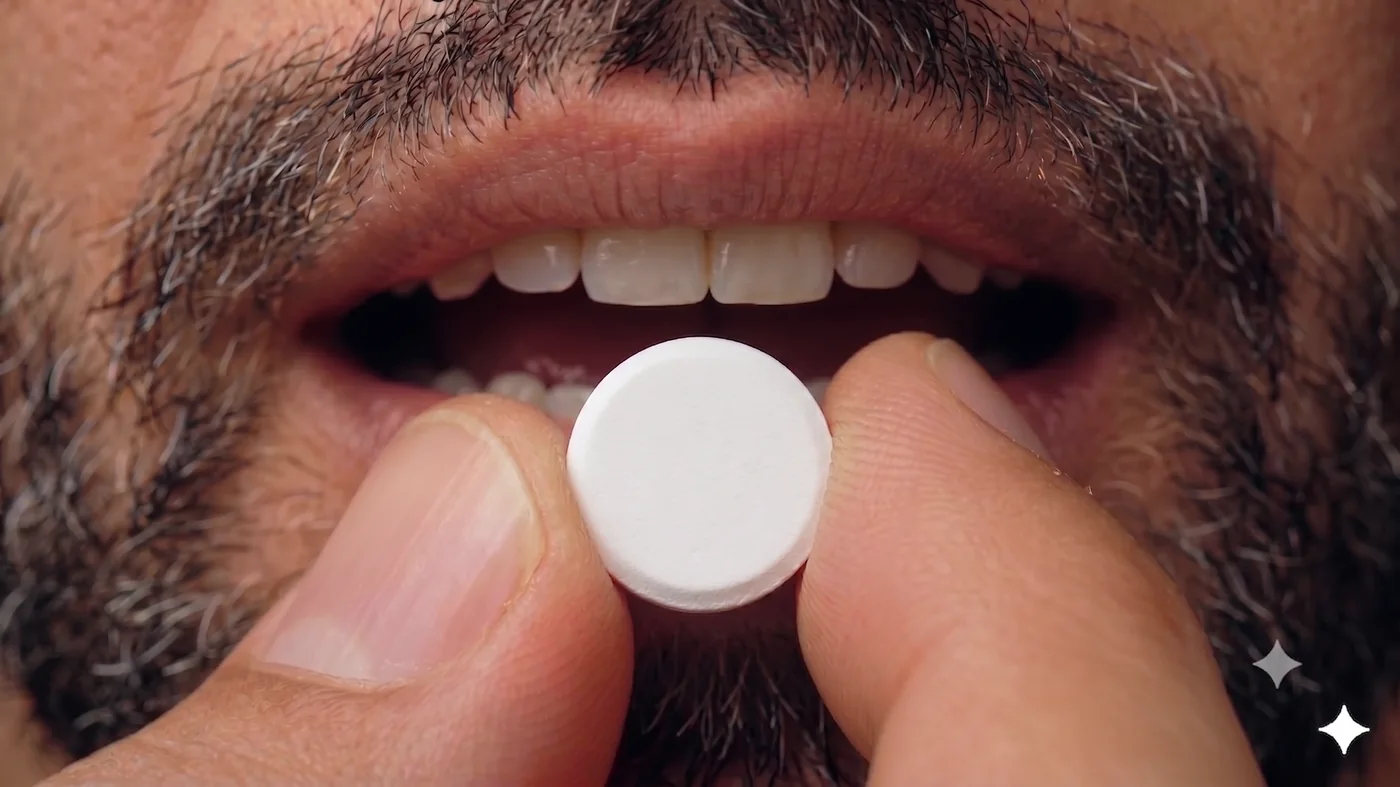
What is Drive?
Drive is a prescription, compounded sublingual tablet formulated for erectile dysfunction. "Compounded" means it's prepared by a licensed compounding pharmacy that combines specific active ingredients into a single tablet: in this case, two well-known ED medicines plus a third that works through the mental pathway. "Sublingual" means it's placed under the tongue to dissolve, rather than swallowed like a standard pill.
The dose is not one-size-fits-all. A licensed provider reviews your health information during an online visit and sets the formulation that's appropriate for you.
The three active ingredients
Most ED pills rely on a single active ingredient. Drive combines three, chosen to work through complementary mechanisms.
Sildenafil
Sildenafil is the active ingredient in Viagra and one of the most widely used ED medications in the world. It belongs to a class called PDE5 inhibitors, which work by relaxing blood vessels and improving blood flow to the penis to help you get and keep an erection when you're aroused. Sildenafil is FDA-approved for erectile dysfunction.
Tadalafil
Tadalafil is the active ingredient in Cialis. It's also a PDE5 inhibitor, so it works on the same blood-flow pathway as sildenafil - but it's known for a notably longer duration of action. Per FDA labeling, tadalafil can support erectile function for up to 36 hours after a dose. Tadalafil is FDA-approved for erectile dysfunction.
Apomorphine
Apomorphine is a dopamine agonist - a compound that activates dopamine signaling in the brain, the neurotransmitter system that helps initiate sexual arousal. This is a fundamentally different mechanism from the PDE5 inhibitors: where sildenafil and tadalafil act on blood flow in the body, apomorphine works centrally, in the brain's arousal pathway, helping trigger the erectile response rather than only supporting it once arousal is already present. It targets the part of an erection that starts in the head, not the plumbing.
Apomorphine is FDA-approved (for another medical condition), but it is not indicated for erectile dysfunction. It is used off-label for ED, and a sublingual form was approved in Europe specifically for ED, supported by significant clinical evidence: in randomized, placebo-controlled trials, sublingual apomorphine produced significantly more erections firm enough for intercourse than placebo. Source In Drive, it is used as part of a compounded preparation.
Why a sublingual tablet?
Sublingual means "under the tongue." Instead of swallowing the tablet, you let it dissolve in the mouth, where the tissue is thin and rich with blood vessels that absorb the medicine directly.
That route matters for timing. A swallowed pill has to move through the stomach and gut and survive first-pass metabolism in the liver before it reaches your bloodstream. Absorbing through the mouth skips part of that journey, which is why sublingual delivery is chosen for a faster onset - as quick as about 15 minutes for some men, versus the 30 to 60 minutes typical of a swallowed tablet. It's also more discreet and convenient, and an easier option for anyone who dislikes swallowing pills.
To be precise: the format changes how quickly and how much of the medicine is absorbed, not the underlying pharmacology of the ingredients. What matters most for results is the active ingredients themselves and whether the treatment is right for you - something your provider helps determine.
Start a confidential online visit. A licensed provider reviews your information and decides whether Drive is appropriate for you.
How to take Drive
Always follow the specific directions from your prescriber and the pharmacy label. In general, a sublingual tablet is used like this:
- Place the tablet under your tongue and let it dissolve fully: don't chew or swallow it whole.
- Take it ahead of anticipated sexual activity, as directed.
- Don't take more than prescribed, and don't combine it with other ED medications unless a provider tells you to.
Remember that ED medicines support an erection in response to arousal; they don't create one on their own.
Onset and duration
Because Drive contains sildenafil and tadalafil, the timing of its effects is shaped by those medicines. Tadalafil in particular is associated with a longer window of action - up to 36 hours2 per FDA labeling for tadalafil as a standalone medicine - which is why effects from Drive may last well beyond a single evening.
Individual experience varies based on your dose, your physiology, and factors like food and alcohol. As with any compounded product, Drive itself has not been studied by the FDA, so the most reliable guidance on what to expect comes from your prescriber.
Side effects and safety
Like all medicines, Drive can cause side effects. Because it contains PDE5 inhibitors, the most common possibilities mirror those of sildenafil and tadalafil:
- Headache
- Facial flushing
- Nasal congestion
- Indigestion or upset stomach
- Dizziness or lightheadedness
The apomorphine component can also contribute to nausea or lightheadedness, particularly when starting out. Most side effects are mild, but you should report anything that concerns you to your provider.
This is exactly why ED treatment requires a provider's review rather than a self-purchase - and why your medical history matters before the first dose.
Is Drive right for you?
Drive is one option among several for treating ED. Whether it's a good fit depends on your health history, the medications you take, and your goals. The only way to know is a consultation with a licensed provider, who can weigh the benefits and risks for your situation. If you'd like to start, HELMD's online visit takes a few minutes.
New to the topic? Our overview of what erectile dysfunction is and how it's treated is a good place to start, and you can compare approaches in HELMD vs. Rugiet.
Frequently asked questions
What is in Drive?
Drive combines sildenafil and tadalafil (two PDE5 inhibitors) with apomorphine, in a compounded sublingual tablet. The dose is set by a licensed provider.
Is Drive FDA-approved?
No. Drive is compounded, and compounded drugs are not FDA-approved4. Its individual ingredients sildenafil and tadalafil are FDA-approved as standalone medications.
How do you take Drive?
Sublingually: place it under the tongue and let it dissolve, following your prescriber's directions.
What are the possible side effects?
Headache, flushing, nasal congestion, indigestion, and dizziness are possible, and apomorphine may add nausea or lightheadedness. Seek care immediately for priapism or sudden vision/hearing changes.
How long does Drive last?
Effects can last up to 24–36 hours, largely influenced by the tadalafil component. Individual results vary.
Takeaways
- Three actives, one tablet. Drive combines sildenafil, tadalafil, and apomorphine: blood-flow and central pathways together.
- Sublingual format. It dissolves under the tongue rather than being swallowed; that's about how it's taken and absorbed, not a superiority claim.
- Long-acting tendency. Effects can last up to 24–36 hours, largely due to tadalafil.
- Compounded, not FDA-approved. The FDA doesn't evaluate compounded drugs; sildenafil and tadalafil are approved on their own.
- Provider review is essential. Nitrate interactions and other factors mean Drive should only be used after a licensed provider clears it.

Dr. Chughtai is a Board-Certified Urologist and the author of 160+ peer-reviewed publications, with fellowship training at Weill Cornell.
Read full bio →Sources
- U.S. Food & Drug Administration. VIAGRA (sildenafil citrate) tablets - Prescribing Information. accessdata.fda.gov
- U.S. Food & Drug Administration. CIALIS (tadalafil) tablets - Prescribing Information. accessdata.fda.gov
- National Institute of Diabetes and Digestive and Kidney Diseases. Treatment for Erectile Dysfunction. niddk.nih.gov
- U.S. Food & Drug Administration. Compounding and the FDA: Questions and Answers. fda.gov
- Drugs.com. Apokyn (apomorphine) - FDA approval history (dopamine agonist; approved for Parkinson's disease). drugs.com
- Dula E, Bukofzer S, Perdok R, George M. Efficacy and safety of fixed-dose and dose-optimization regimens of sublingual apomorphine versus placebo in men with erectile dysfunction. Urology. 2000. pubmed.ncbi.nlm.nih.gov